From Arctic amplification to polar bear habitat. Newest first.
Stochastic deep-learning downscaling of coastal Arctic sea ice thickness
2025 – present · Ph.D. research, University of Washington · including a summer as a Visiting Graduate Researcher at NSF NCAR, Boulder (Jun – Aug 2026) Manuscript in preparation
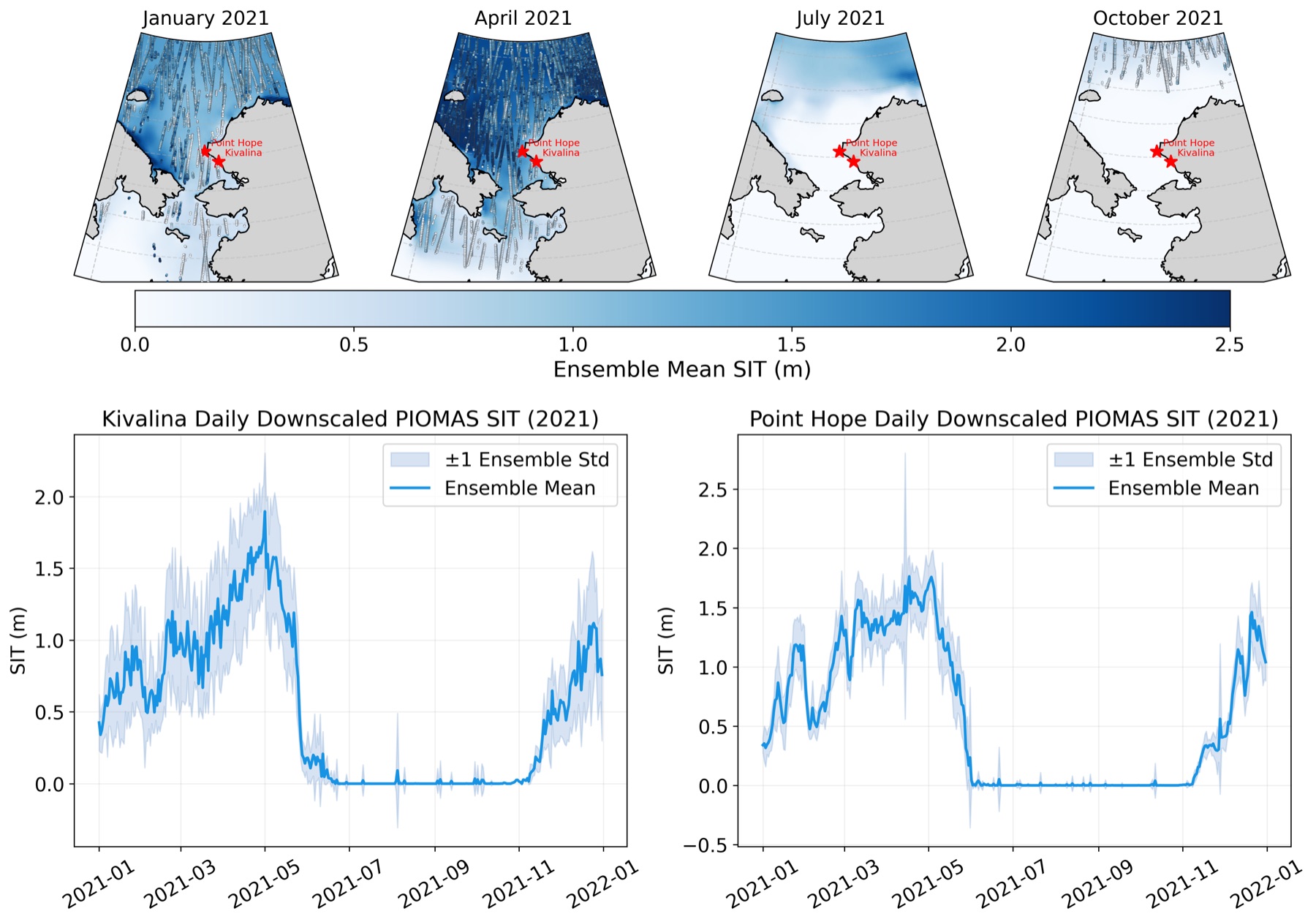
Coastal Arctic communities need sea ice information at scales far finer than global climate models resolve. I’m developing EngressNet, a stochastic residual U-Net that statistically downscales sea ice thickness and produces an ensemble of plausible high-resolution fields rather than a single blurred answer.
Land-mask conditioning and coastal-band loss upweighting to keep skill where it matters most — along the coast.
Systematic ablations (cosine weighting, architectural depth, stochastic refinement) to isolate what each component contributes under limited CMIP6 training data.
Reproducible PBS training pipelines on NCAR’s Casper HPC system with version-controlled conda environments.
EngressNet applied to PIOMAS for 2021. Top: ensemble-mean downscaled sea ice thickness in January, April, July, and October around Point Hope and Kivalina, Alaska. Bottom: daily ensemble mean (±1 standard deviation) at each community.
Sea ice seasons and polar bear habitat in Hudson Bay
2025 · Assistant Climate Data Scientist, Polar Bears International (remote)
Polar bears in Hudson Bay depend on sea ice to hunt; the length of the ice-free season directly affects their body condition and survival. I built the data pipeline Polar Bears International uses to track sea ice breakup, freeze-up, and ice-free days for the Western and Southern Hudson Bay subpopulations.
Acquired and processed four satellite passive-microwave sea ice concentration records (NOAA/NSIDC G02202, G10016, NSIDC-0803, AMSR2) spanning 1978–2025.
Cross-validated breakup, freeze-up, and ice-free-day metrics across sensor platforms and spatial resolutions (12.5 km and 25 km).
Produced sea ice trend maps and time series for habitat assessments.
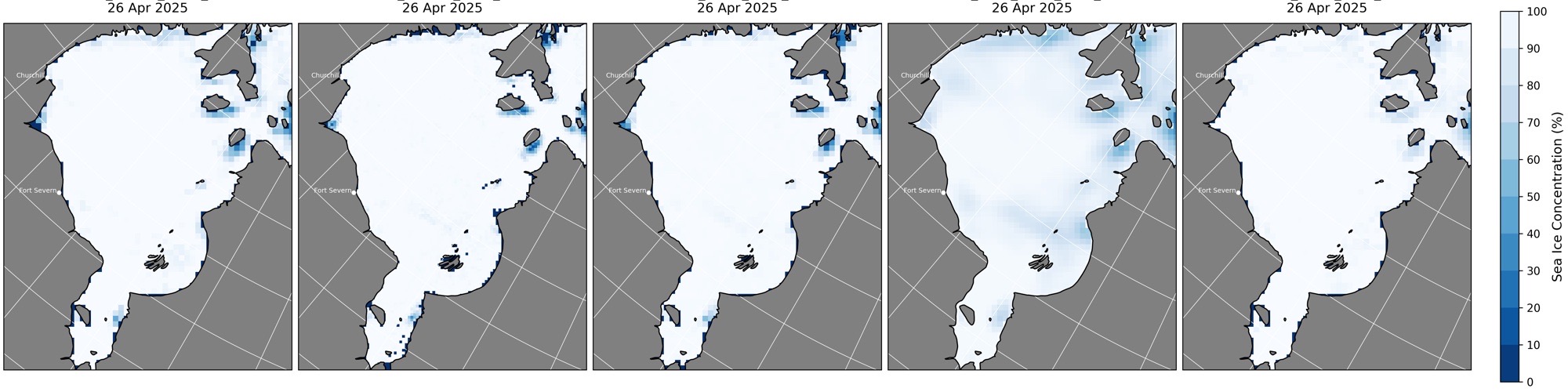
Sea ice concentration over Hudson Bay on 26 April 2025, compared across the satellite products in the pipeline.
Why April stands out: monthly impacts of internal variability on Arctic amplification
2026 · M.S. research, University of Washington
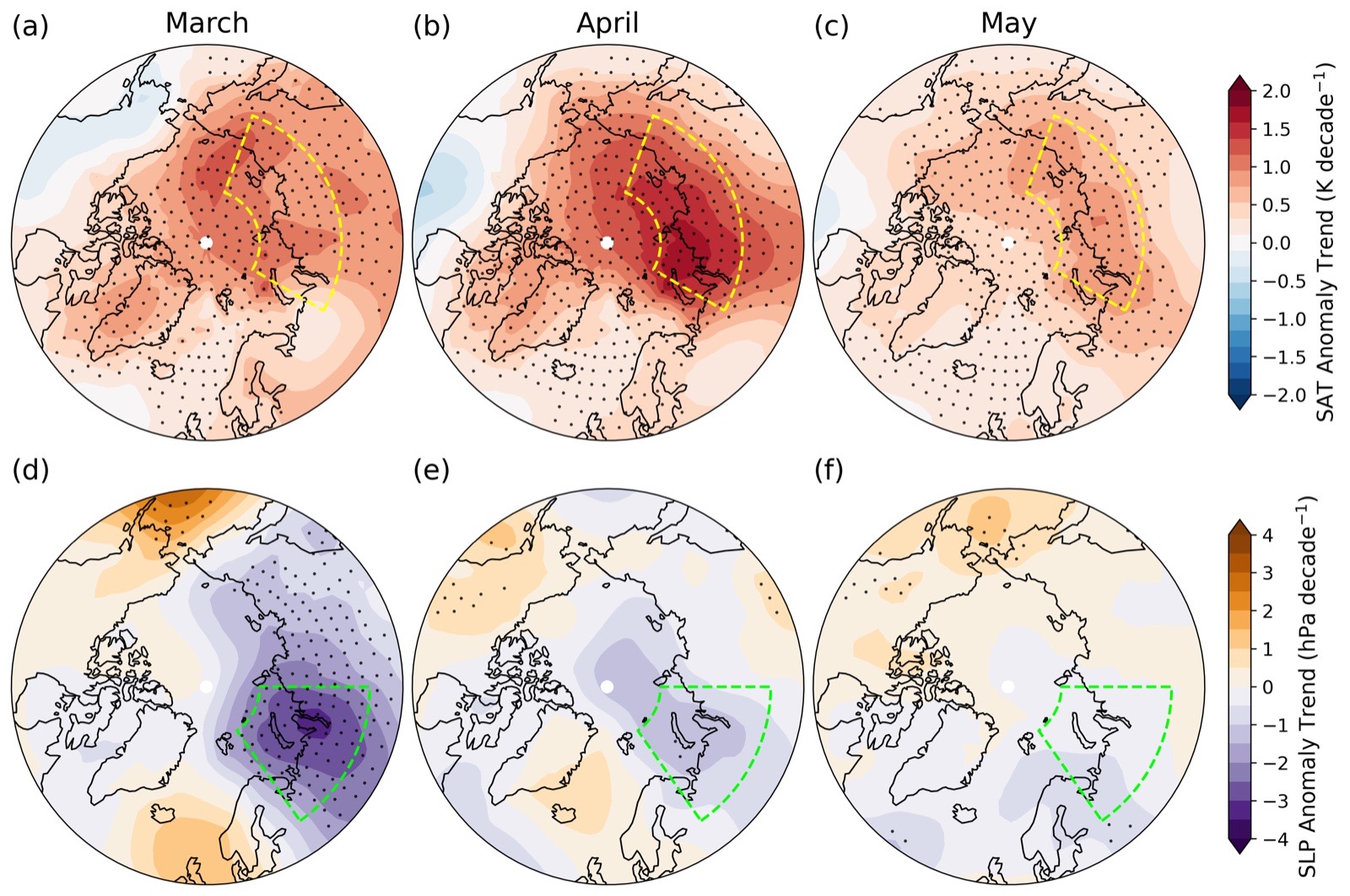
Observed Arctic amplification peaks unexpectedly in April. Training CNNs on sea level pressure and surface air temperature from a CMIP6 multi-model ensemble separately for March, April, and May, I isolated the month-specific, internally driven part of Arctic warming and the circulation patterns behind it, to understand why April stands out.
Monthly surface air temperature (top) and sea level pressure (bottom) anomaly trends for March, April, and May. From Gale et al. (2026), JGR Atmospheres.
The role of internal variability in springtime Arctic amplification
2026 · M.S. research, University of Washington
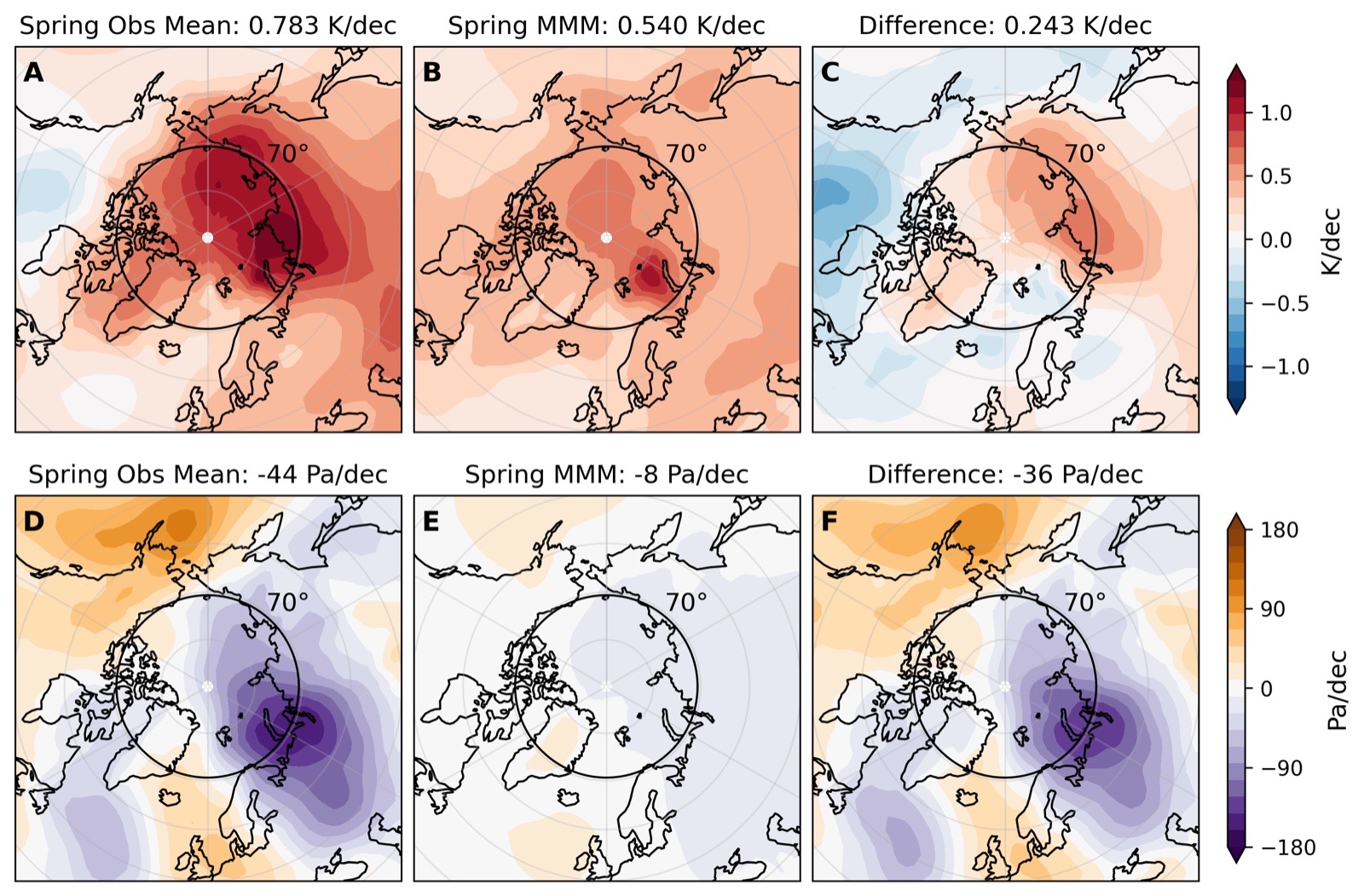
Climate models underestimate how fast the Arctic has warmed in spring relative to the rest of the globe. Using machine learning to separate internal climate variability from the forced response in observations, reanalyses, and large ensembles, I showed that internal variability explains nearly half of the observation–model discrepancy in springtime Arctic amplification over 1980–2022.
Spring surface air temperature (top) and sea level pressure (bottom) trends in observations, the CMIP6 multi-model mean, and their difference. From Gale et al. (2026), Journal of Climate.
Constraining mantle viscosity with ANU and ICE-6G ice histories
2024 · Undergraduate Research Assistant, Department of Geophysics, University of Colorado Boulder · advised by Shijie Zhong and Michael Ritzwoller Published in the University of Colorado Honors Journal (2024)
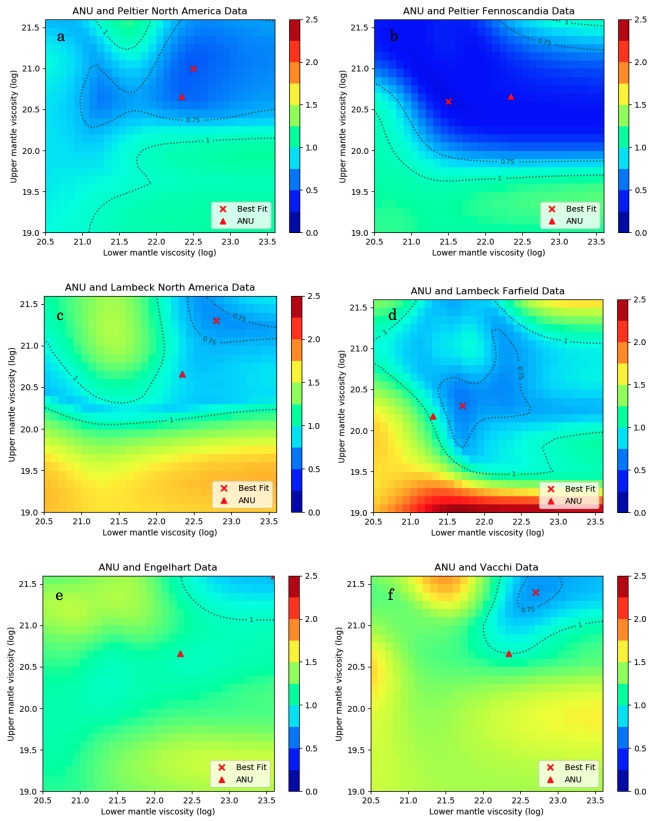
Glacial isostatic adjustment (GIA) models need an ice history and a mantle viscosity structure to predict relative sea level since the Last Glacial Maximum, but viscosity is poorly constrained. I ran 864 mantle viscosity models with the ANU and ICE-6G ice histories and compared the predicted relative sea level against six field datasets, showing how strongly the quality of field data controls the resulting viscosity constraints and where each ice model succeeds or falls short.
Relative sea level misfit across upper- and lower-mantle viscosities for the ANU ice model, compared against six field datasets (a–f). × marks the best fit; ▲ marks the ANU viscosity.
Iceland's disappearing glaciers: Vatnajökull, hydrology, and hydropower
2022 · Glaciology Research Student, School for International Training, Reykjavík, Iceland · advised by Sonya Ahamed
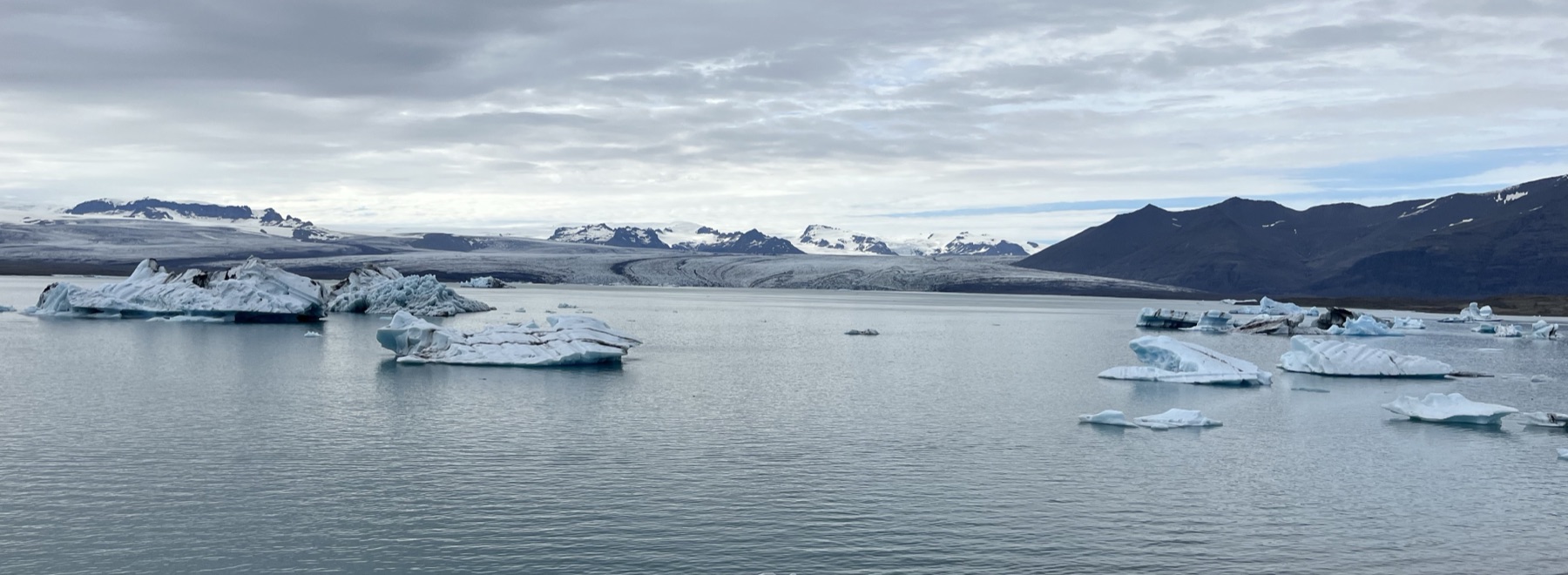
Six weeks traveling Iceland studying renewable energy and climate. I synthesized research on the Vatnajökull ice cap — how warming changes its ice dynamics, melt mechanisms, and downstream hydrology — and what that means for long-term water storage in Iceland’s hydropower sector.
Icebergs in Jökulsárlón, the lagoon at the foot of Breiðamerkurjökull, an outlet glacier of Vatnajökull. Photo from the program, July 2022.
Induced seismicity in the Oklahoma Arbuckle Group
2019 · High school research project, 4th place, International Science and Engineering Fair 2019
Six months of digging through oil and gas industry and Oklahoma Corporation Commission data to relate wastewater injection into the Arbuckle Group to earthquake frequency and magnitude — and how human-made earthquakes might be mitigated.
Earlier experience
Aug 2021 – May 2022Bio-Computing Research Assistant, University of Colorado Boulder (Orit Peleg lab)MATLAB analysis of honeybee swarm structure to understand self-assembly mechanics.
May – Aug 2021Planetary Science Instrumentation Research Intern, Lockheed Martin Advanced Technology Center, Palo Alto, CAPython data tools for the GeoCARB satellite science instrument.
Aug 2020 – Jan 2021Student Technical Writer, National Snow and Ice Data Center (NSIDC) / CIRES, Boulder, COMetadata documentation and the RAMP satellite web page migration.
Jul 2020 – Jan 2021Astrophysics Research Assistant, University of Colorado BoulderOrbit design for a NASA mission proposal surveying Paschen-alpha emission in the galactic plane.
May – Jul 2020Electrical and Test Engineering Intern, Lockheed Martin, Littleton, COTest procedures and scripts for electrical testing of the GOES satellite series.
Aug – Dec 2019Atmospheric Science Research Assistant, NOAA Global Monitoring Division, Boulder, COArduino sensor programs and hardware for the Active AirCore weather-balloon gas sampler.
Jan – Aug 2019Mechanical and Systems Engineering Intern, Lockheed Martin, Littleton, COHands-on satellite integration work and a trade study for the GOES program's integration and test documentation.