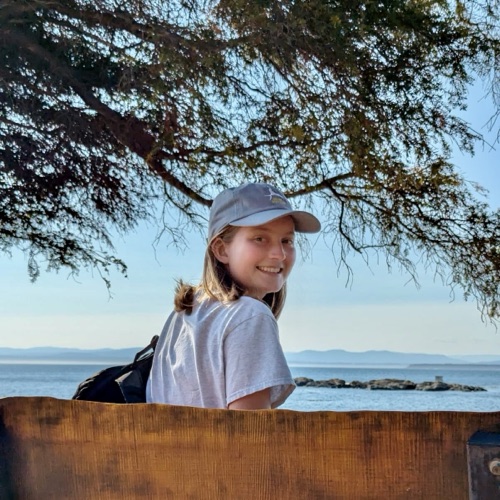
Hi, I'm Sky.
(she/her) · PhD student, Atmospheric and Climate Science, University of Washington
I study why the Arctic is warming so fast, and what that means for the sea ice and the people who depend on it. I work at the intersection of polar climate, climate variability, and machine learning: separating internal variability from forced change in Arctic amplification, and downscaling climate model output into sea ice predictions that are useful for communities. I’m co-advised by Cecilia Bitz and Qiang Fu.
I care about action-oriented, collaborative science that bridges data and decision-making, which is why I’ve also done sea ice analysis for Polar Bears International and co-chair our department’s K-12 outreach committee.
Outside of research, you’ll find me running, skiing, hiking, backpacking, road cycling, or playing volleyball, or else watching movies and spending time with my family and dog.
News
2026
- Oct“Why April Stands Out” — on monthly impacts of internal variability on Arctic amplification — is out in JGR: Atmospheres.
- AugWrapped up my summer at NCAR and headed back to UW to keep working on sea ice downscaling.
- JunStarted as a Visiting Graduate Researcher at the NSF National Center for Atmospheric Research in Boulder, working on deep-learning downscaling of Arctic sea ice.
- JunTalk at the CESM Workshop session Harnessing Machine Learning for CESM.
- MayFirst-author paper “The Role of Internal Variability in Springtime Arctic Amplification from 1980 to 2022” published in Journal of Climate.
- MayTalk at the PAMIP Seminar.
- FebTalks at the UW Atmospheric and Climate Science Seminar and the CESM Polar Climate Working Group Winter Workshop.
2025
- DecPoster at AGU25 on internal variability in observed Arctic spring warming and the underlying coupling mechanisms.
- SepWrapped up my sea ice data work with Polar Bears International, delivering breakup, freeze-up, and ice-free-day metrics for the Western and Southern Hudson Bay polar bear subpopulations.
- JulStarted my Ph.D. at UW, focusing on deep-learning downscaling of Arctic sea ice for coastal communities.
- JunFinished my M.S. at UW and joined Polar Bears International as an Assistant Climate Data Scientist.
- JunAwarded a CICOES Graduate Student Fellowship.
- MarTalk and poster at Arctic Science Summit Week (ICARP IV) in Boulder.
2024
- DecPoster at AGU24 on the seasonality of Arctic amplification.
- OctTalks at the PAMIP2 Workshop and the HiLAT-RASM All-Hands Meeting.
2023
- SepStarted graduate school in Atmospheric and Climate Science at the University of Washington.
- MayGraduated summa cum laude from CU Boulder (B.S. Engineering Physics) and received the John Wahr Award in Geophysics.
Positions
- Jul 2025 – presentPh.D. Student, Atmospheric and Climate Science, University of WashingtonDeep-learning downscaling of coastal Arctic sea ice thickness. Advised by Cecilia Bitz and Qiang Fu.
- Jun – Aug 2026Visiting Graduate Researcher, NSF National Center for Atmospheric Research (NCAR), Boulder, COStochastic deep-learning downscaling of Arctic sea ice thickness.
- Jun – Sep 2025Assistant Climate Data Scientist, Polar Bears International (remote)Satellite sea ice metrics for Hudson Bay polar bear habitat.
- Sep 2023 – Jun 2025M.S. Student, Atmospheric and Climate Science, University of WashingtonInternal variability and springtime Arctic amplification. Advised by Qiang Fu.
More on these in research.
Education
- expected Mar 2028Ph.D., Atmospheric and Climate Science, University of Washington
- Jun 2025M.S., Atmospheric and Climate Science, University of Washington
- May 2023B.S., Engineering Physics, summa cum laude, University of Colorado BoulderMinors in Applied Mathematics and Atmospheric & Oceanic Sciences.
Awards
- 2026HiLAT-RASM Honorable Mention
- 2025CICOES Graduate Student Fellowship
- 2023John Wahr Award in Geophysics